police clearance certificate translations - certified police clearance certificate translator English German and 75 more languages

Certified translation › Police clearance certificate

Police clearance certificate for German authorities — certified translation.

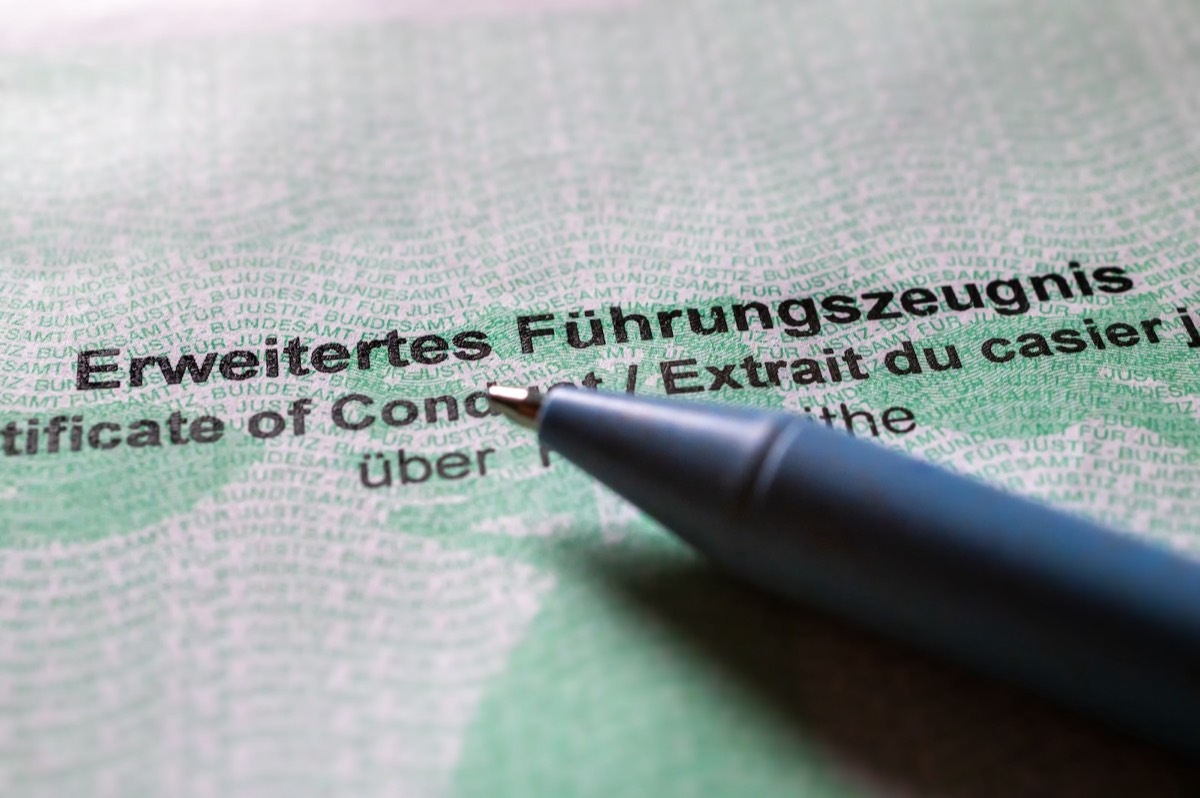
Your German police clearance certificate (Führungszeugnis) is translated at FÜD by a court-authorised sworn translator — certified, with a certification note, stamp and signature confirming accuracy and completeness. German authorities accept it nationwide — the naturalisation authority, the immigration office for a residence permit, or a chamber for admission to a regulated profession — whenever the original is not in German. The German equivalent, the Führungszeugnis, is issued separately by the Federal Office of Justice (Bundesamt für Justiz) and now comes in German, English and French. You upload the certificate and receive a binding fixed price from €59, certification and shipping included.

  • Recency mattersoften valid only months
  • Certified copy translatedlayout preserved
  • Target-country languagegoverns acceptance
  • 4.6 · Trustpilot

Court-authorised (sworn) translators · recognised by German authorities nationwide · binding fixed price, from € 0.89 per standard line

DIN EN ISO 17100registered · Reg. 7U517
Accepted by authoritiescertification note included
Price up frontbinding fixed price
ConfidentialGDPR-compliant · NDA on request

Short & clear

Which certified translation do German authorities need?

A police clearance certificate — certificate of good conduct, criminal-record certificate — issued abroad must be submitted to German authorities as a certified German translation whenever it is not in German. You will meet this most often in naturalisation, a residence permit, or registration in a regulated profession.

The German certificate, the Führungszeugnis issued by the Federal Office of Justice, is nowadays produced in German, English and French, so it usually needs no translation within Germany. FÜD translates the foreign certificate; the decision on your application stays with the authority.

Step by step

Getting your good-conduct proof ready — in order.

A few clear steps, written as the questions people actually ask their case officer.

Which certificate does the authority want?

Ask the case officer whether they need a German Führungszeugnis, a police clearance certificate from your country (or countries) of previous residence, or both. Naturalisation and some permits ask for both; the requirement is individual.

How do you obtain the German Führungszeugnis?

If you have lived in Germany, you request a Führungszeugnis from the Federal Office of Justice (Bundesamt für Justiz) — at your local registration office or online. Under § 30 BZRG anyone aged 14+ can apply. Current German certificates come in German, English and French.

How do you get the foreign certificate?

You request a police clearance certificate from the competent authority in your home country, usually through its police or justice ministry, sometimes via the German mission abroad. It is issued in that country's language and format.

Does the foreign certificate need an apostille?

Frequently. Many authorities require the foreign document to carry an apostille or legalisation to prove it is genuine. Obtain that in the issuing country first, because the apostille is stamped on the document and is translated with it.

Who translates it, and when?

A court-authorised translator produces the certified German translation the authority accepts. Because these certificates often have to be recent (many offices want one issued within the last three to six months), we time the translation close to your submission.

German or foreign — which needs translating?

Führungszeugnis vs a foreign police clearance certificate.

People often ask which document to translate. The honest answer: usually the foreign one, not the German one.

German certificate

Führungszeugnis

What it is
The German certificate of good conduct, issued by the Federal Office of Justice from the Federal Central Criminal Register.
Language
Current certificates are issued in German, English and French.
Translation
Usually not needed within Germany; for use abroad an apostille (not a translation) is often the requirement.

Home-country certificate

Foreign police clearance certificate

What it is
A certificate of good conduct / criminal record from your country of nationality or previous residence.
Language
Issued in that country's language — often a non-Latin script.
Translation
Certified German translation required for German authorities if not in German. This is FÜD's job.

EU nationals

European certificate

What it is
For EU citizens, a European certificate of good conduct that includes entries from the country of nationality.
Language
Issued by the German Federal Office of Justice for eligible EU residents.
Translation
Where a separate home-country certificate is issued abroad and not in German, it is translated.

The practical takeaway

Don't pay to translate a modern German Führungszeugnis for a German office — it is already trilingual. Do get a certified translation of any foreign police clearance certificate that is not in German. If you are unsure which your case needs, we will look at what the authority asked for and translate only what is required.

Documents you must translate

What a good-conduct file usually contains.

The exact set is defined by your authority. These are the documents we most often translate for it.

Documents for a police-clearance file and whether a certified translation is usually required
DocumentWhy it is neededCertified translation
Foreign police clearance certificate / criminal recordProves good conduct in your country of nationality or previous residence.Certified translation if not in German — the core document.
German FührungszeugnisCovers your record while resident in Germany.Usually no translation in Germany (issued in DE/EN/FR).
Court judgment / extract (if any entry exists)Some authorities want context for an entry on the record.Certified legal translation — wording matters.
Passport / identity pageTies the certificate to your identity and exact name spelling.Certified translation if the authority asks.
Cover letter / application form (home authority)Occasionally submitted alongside the certificate.Certified translation on request.

"No entries" must read as unambiguously clean

The heart of most of these certificates is a single line stating there are no entries. Rendered loosely, that line can read as evasive to a German case officer. We translate the standard "no entries" wording exactly and carry any register terminology precisely, so a clean record reads as clean.

Apostille & legalisation

Authenticity is a separate step — and FÜD does not issue apostilles.

For a foreign police clearance certificate, German authorities often require an apostille (Hague Convention states) or legalisation to confirm the document is genuine. That is separate from translating it, and it is done in the country that issued the certificate.

The apostille is placed by the competent authority in the issuing countryFÜD does not issue apostilles. Obtain it on the original first; we then translate the certificate and its apostille together, so the authority receives one consistent, certified set. Going the other way — using a German Führungszeugnis abroad — the usual requirement is an apostille via the Federal Office of Justice, and sometimes a translation into the destination country's language.

Languages & typical origin countries

Which police clearance certificates we translate most.

We translate criminal-record certificates from over 70 languages into German. The most frequent cases come from:

Middle East & N. Africa

  • Arabic (Syria, Iraq, Egypt)
  • Persian / Dari
  • Turkish
  • French (Maghreb)

Eastern Europe & CIS

  • Russian, Ukrainian
  • Georgian, Armenian
  • Romanian, Serbian
  • Kazakh, Uzbek

Asia

  • Hindi, English (India)
  • Chinese, Vietnamese
  • Filipino / Tagalog
  • Thai, Indonesian

Africa & Americas

  • English (Nigeria, Ghana)
  • Amharic, Tigrinya
  • Spanish (Latin America)
  • Portuguese (Brazil)

Non-Latin scripts need rule-based romanisation of your name, matched to your passport — decisive when the certificate is filed with a naturalisation record. See all languages.

Common pitfalls

Where good-conduct files get queried — and how we prevent it.

A police clearance certificate looks simple, which is exactly why the mistakes are avoidable. These are the ones we see.

Common pitfalls with police-clearance translations and how FÜD resolves them
PitfallWhy it goes wrongHow FÜD solves it
Paying to translate a German FührungszeugnisModern German certificates are already trilingual; translating one for a German office is wasted money.We tell you plainly when no translation is needed and translate only the foreign certificate.
Name spelled differently from the passportA transliteration guessed by sound diverges from your ID, and the file is queried.Your name is romanised by the rules and matched exactly to the passport spelling.
"No entries" rendered vaguelyA loose rendering of the clean-record line can read as evasive to a case officer.The standard "no entries" wording is translated exactly, so a clean record reads clean.
Certificate too oldMany offices want a certificate issued within the last three to six months; translating a stale one wastes it.We flag recency requirements and turn the translation around quickly, express if needed.
Apostille missing or added after translatingIf required and stamped afterwards, the apostille itself is untranslated — and rejected.We advise apostille first, then translate certificate and apostille as one set.

Why exactness matters here most

This document goes on a permanent record — a naturalisation file, a professional register. A clean certificate has to read as unambiguously clean, and your name has to match your ID exactly. That precision is the whole value of a certified professional translation.

A clean record must read as unambiguously clean.

Exact "no entries" wording, passport-matched name, certified — accepted the first time.

Process with FÜD

From upload to certified translation — three steps.

1 · Upload

Send the certificate

What you do
Upload a scan of your police clearance certificate (with apostille if you already have it) and tell us the purpose — naturalisation, permit, profession.
What we do
We check the language and confirm whether an apostille is needed first.

2 · Fixed price

Binding quote up front

What you do
Approve the quote — one binding fixed price, delivery date included.
What we do
A court-authorised translator renders the certificate, name matched to your passport, "no entries" wording exact.

3 · Certified + shipping

PDF now, original by post

What you do
Receive a certified PDF in advance and the stamped original by post for the authority.
What we do
Deliver on the agreed date; 24-hour express available before a deadline.

Upload document

Quote & price

What does a police-clearance translation cost?

A police clearance certificate is a short standard document, usually a flat fee per document. Longer records are priced per standard line. We name a binding fixed price after a quick review — certification and postal delivery included.

Binding fixed price
from € 0.89 / standard linethe certificate itself usually at a flat fee per document
Price up front · no unannounced extra costs
Certified translation by a court-authorised translatorincluded
Name romanised & matched to your passportincluded
Certification note recognised by authoritiesincluded
Advance PDF & postal delivery of the originalincluded
Specialist revision & final checkincluded

The certificate is billed at a flat fee per document; longer records from € 0.89 per standard line (55 characters incl. spaces). We name the exact amount after a brief review. How the price is made up →

Request a quote

Sources & legal basis

Verified sources for this page.

The facts above come from the German authority that runs the Federal Central Criminal Register and the relevant statute.

FAQ

Police clearance certificate & translation — frequently asked questions.

Do I need to translate my foreign police clearance certificate for German authorities?

Yes, if it is not in German. A police clearance certificate (certificate of good conduct / criminal record) issued abroad generally has to be submitted to German authorities as a certified German translation — for naturalisation, a residence permit, or registration in a regulated profession. The translation must come from a court-authorised (sworn) translator with a certification note.

What is a Führungszeugnis and do I need to translate it?

A Führungszeugnis is the German certificate of good conduct, issued by the Federal Office of Justice (Bundesamt für Justiz) from the Federal Central Criminal Register. Current German certificates are issued in German, English and French, so a German Führungszeugnis usually does not need translating within Germany. What typically needs a certified German translation is a police clearance certificate from your home country.

Which certificate do German authorities want — German or from my home country?

It depends on the procedure. For naturalisation and many permits, authorities may ask for both a German Führungszeugnis (if you have lived here) and a police clearance certificate from your country or countries of previous residence. The foreign one, if not in German, needs a certified translation. Your case officer sets the exact requirement; we translate whatever they ask for.

Does the translation have to be certified?

Yes. German authorities accept only certified translations from a court-authorised (sworn) translator — in German an ermächtigter Übersetzer, authorised under German state law. The translator adds a stamp, signature and certification note. A self-made or uncertified translation is not accepted.

Does my police clearance certificate need an apostille?

Often, for a foreign certificate — but that is separate from the translation. Many authorities require the foreign document to carry an apostille (Hague Convention states) or legalisation to confirm authenticity. The apostille is issued by the competent authority in the country that issued the certificate; FÜD does not issue apostilles. We advise on sequencing so the certificate and its translation are accepted together.

How much does a certified translation of a police clearance certificate cost?

A police clearance certificate is a short standard document, usually billed at a flat fee per document; longer records are priced per standard line, from € 0.89 per standard line. After a quick review we name a binding fixed price, certification and postal delivery included. A 24-hour express option is available.

My Egyptian criminal-record certificate was translated with the "no entries" line exact and my name matched to my passport. The naturalisation office in Hamburg accepted it without a single question.
★★★★★

M. El-Sayed · naturalisation, Hamburg

Upload document Prices